I want to take a moment to share something personal about how this work has been made.
Not the polished version.
Not the highlight reel.
But the real, human process.
Depathologizing Neurodivergence didn’t come from a perfect plan or a professional production team. It came from listening. From paying attention to what my body and nervous system could actually do, and letting the creative process form around that instead of forcing myself into one that was never designed for me.
From the beginning, this project was meant to live in two forms: print and audio. Page and voice. For many of us, access isn’t a preference—it’s a need. And honoring that shaped every decision I made along the way.
Most of what you’ll read or hear from me began as voice recordings. I spoke while walking, sitting in my car, or late at night when my body finally softened enough to let words move. Speaking is where my thoughts organize themselves. It’s where I can feel what’s true before it ever reaches the page.
Those recordings were messy, alive, and deeply human. They became the raw material for everything that followed.
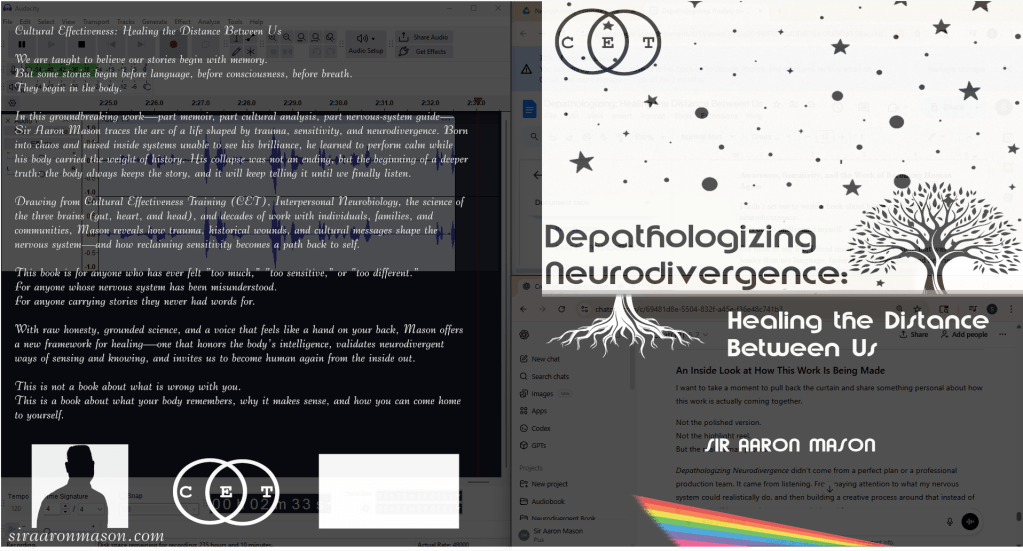
From there, I used artificial intelligence as an assistive tool. Not to replace my voice or shortcut the work, but to help translate spoken language into written form while preserving its integrity. The only paid tool I used was ChatGPT—twenty dollars a month—which created space to keep creating without burning myself out.
For the audiobook, I used Audacity, a free, open-source audio program, to edit and shape the recordings so they could land gently in someone else’s body. The audiobook is distributed through Audible, allowing this work to live fully in voice, not as an afterthought but as an equal form of access.
The print version was written in Google Docs and stored in Google Drive. Drafts, revisions, half-formed ideas, and finished chapters all lived together without pressure to be perfect before they were allowed to exist.
The cover art and visuals were created using GIMP, another open-source tool. And when it came time to share this work more widely, I used Canva to create distributed social media content—quote graphics, reflections, and visual excerpts that allow the work to travel without overwhelming the creative process.
I’m sharing all of this because I want something to be clear.
This book wasn’t built on hustle.
It wasn’t built on perfection.
It wasn’t built on having the “right” tools.
It was built on accessibility.
On nervous-system honesty.
On letting the work be made the way my body allows.
Depathologizing Neurodivergence will be released on January 1, 2026, in both print and audiobook formats. Naming that date matters—but what matters more is how the work was made.
If you’ve been holding a story, a project, or a creative impulse and telling yourself you’re not ready, I hope this loosens that belief just a little.
You’re not behind.
You’re not missing something.
You already have enough.
Thank you for being here.
 SirAaronMason.com
Leave a comment