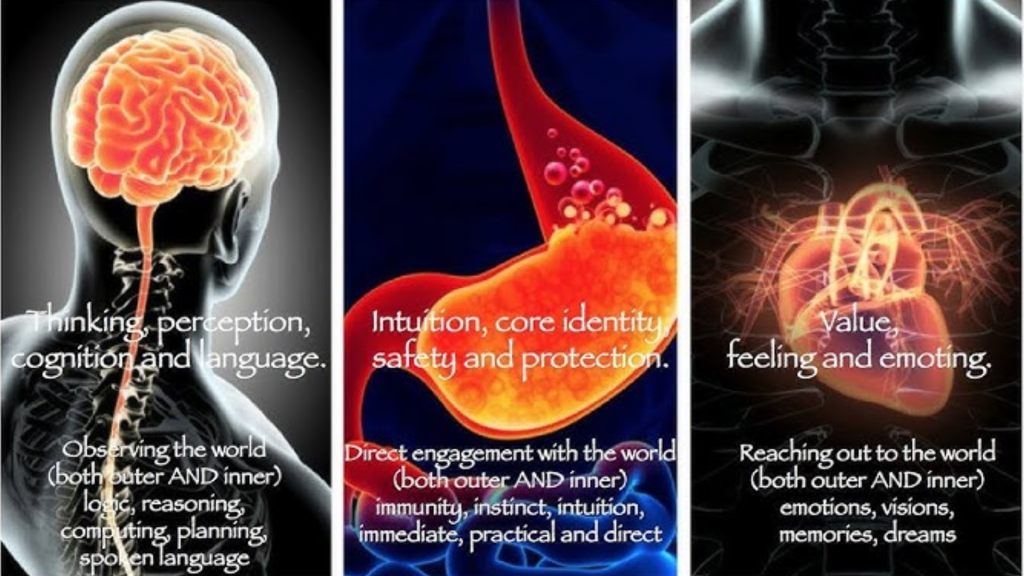
In Parts 1 and 2, we explored neurodivergence through historical trauma, CET’s developmental stages, and the powerful integration of Awareness and Sensitivity. But CET also offers another core framework—one that sits at the center of emotional intelligence, embodiment, and nervous system literacy:
The Three-Brain Model:
Gut Brain (Instinct)
Heart Brain (Emotion)
Head Brain (Cognition)
When we bring this model into conversation with neurodiversity, an extraordinary truth reveals itself:
Neurodivergence isn’t just a difference in how someone thinks.
It’s a difference in how someone feels, senses, perceives, and navigates safety at every level of the nervous system.
Let’s break this down.
The Gut Brain — Instinct, Intuition, and Safety
The enteric nervous system—often called the “second brain”—is responsible for:
- regulation of danger cues,
- instinctive responses,
- gut feelings,
- visceral sensations,
- interoception (awareness of internal states),
- and core survival impulses.
For many neurodivergent people, the gut brain often exists in a state of heightened sensitivity. This isn’t paranoia—it’s physiology.
What Gut-Based Neurodivergence Can Look Like
- Feeling danger in “normal” environments
- Rapid overwhelm in unpredictable spaces
- Strong intuitive awareness
- Intense reactions to internal sensations
- Difficulty with hunger/fullness cues
- Digestive issues linked to stress
- Hypervigilance rooted in past experiences
- Nervous system cues that activate faster than words can form
This is not a disorder—it’s a nervous system tuned to the world’s volume at a different pitch.
Historical trauma amplifies this. Families and cultures exposed to violence, assimilation, or systemic oppression often pass down gut-level vigilance at the neurobiological level. Epigenetics leaves footprints.
Through a CET lens, the Gut Brain of neurodivergent individuals often carries:
- inherited alertness from ancestors who survived danger
- intuitive intelligence that was dismissed as “overreacting”
- sensory precision that was punished instead of honored
The Heart Brain — Emotion, Belonging & Co-regulation
The heart brain—the cardiac nervous system—governs emotional attunement, connection, empathy, and relational safety.
For neurodivergent people, the heart brain is often misunderstood. Many neurodivergent individuals are either portrayed as too emotional or not emotional enough.
In CET’s framing, neither label is accurate.
Heart-Based Neurodivergence Often Shows Up As:
- Deep, intense emotions
- Rapid emotional shifts
- Difficulty naming feelings but feeling them strongly
- Empathy that is overwhelming, not absent
- Rejection Sensitivity Dysphoria (RSD)
- Difficulty with co-regulation when overstimulated
- Relational wisdom that is nonlinear or intuitive
The heart brain is where neurodivergence and historical trauma often collide most intensely.
Because when a child with a sensitive nervous system grows up in environments that:
- punish emotional expression,
- shame sensory needs,
- pathologize difference,
- or deny cultural identity—
the heart learns to protect itself.
This protection might look like:
- masking emotions
- shutting down
- dissociating
- people-pleasing
- hyper-independence
- relational withdrawal
- or emotional flooding
The heart brain doesn’t forget.
It remembers every moment someone’s authentic emotional expression was unsafe.
The Head Brain — Thinking, Processing, and Pattern Recognition
The head brain—the neocortex—is what most people mean when they talk about neurodiversity. But it’s only one piece of the picture.
For neurodivergent people, the head brain often functions differently in ways that bring both challenges and strengths, depending on the environment.
Head-Based Neurodivergence May Include:
- nonlinear or relational thinking
- high creativity
- hyperfocus
- difficulty with transitions
- executive functioning differences
- complex problem-solving
- divergent learning styles
- innovative pattern recognition
- difficulty with rote, meaningless tasks
- perfectionism or paralysis
But culture often measures intelligence through:
- standardization
- compliance
- memorization
- linear logic
- and specific communication styles
This means neurodivergent cognitive strengths often go unnoticed, while the struggles become overemphasized.
When CET’s Awareness and Sensitivity combine, we see the truth:
The head brain is not “broken”—it’s brilliant in ways the dominant culture doesn’t know how to interpret.
And when someone’s cognition doesn’t align with the expectations of schools, workplaces, or families, internal conflict emerges.
The Three-Brain Conversation: Neurodivergence as an Internal Dialogue
Here’s where CET becomes powerful:
The nervous system is not one brain—it’s a relationship between three.
And for neurodivergent people, these three brains often communicate on frequencies that others do not understand.
The Gut Says:
“This environment doesn’t feel safe. I need predictability.”
The Heart Says:
“I want connection, but I’m overwhelmed.”
The Head Says:
“I need more time, space, or structure to process this.”
When these messages conflict or go unheard, the individual becomes dysregulated.
This isn’t a behavior problem.
This isn’t defiance.
This is the nervous system trying its best to protect the person.
Neurodivergence Through the Polyvagal Lens: A CET Expansion
The three-brain model aligns with polyvagal theory, which explains how neurodivergent people often have more reactive or sensitive autonomic states.
NEUROCEPTIVE SAFETY (Green Zone / Ventral Vagal)
- calm focus
- relational connection
- creativity
- clarity
- curiosity
NEUROCEPTIVE DANGER (Yellow Zone / Sympathetic)
- restlessness
- hyperfocus
- agitation
- distractibility
- emotional flooding
- sensory overwhelm
NEUROCEPTIVE LIFE-THREAT (Red Zone / Dorsal Vagal)
- shutdown
- dissociation
- immobilization
- fatigue
- numbness
- withdrawal
For neurodivergent people, these shifts can happen:
- faster
- more intensely
- with more triggers
- or with less predictability
Not because they are fragile—but because their systems perceive more.
What CET Teaches Us About Supporting Neurodivergent Nervous Systems
CET doesn’t ask neurodivergent people to change who they are.
It asks us to change how we interpret their nervous system.
1. Honor the Gut Brain
- Create predictable environments
- Respect sensory cues
- Believe people when they say they feel overwhelmed
- Build safety before skills
2. Support the Heart Brain
- Co-regulate instead of correct
- Use relational repair
- Validate emotional intensity
- Understand cultural and historical trauma wounds
3. Empower the Head Brain
- Offer time for processing
- Provide choice and autonomy
- Teach strategies that align with brain functioning
- Focus on strengths, not conformity
4. Integrate All Three
- Don’t treat cognitive symptoms without understanding sensory needs
- Don’t address behavior without addressing safety
- Don’t push skills when the nervous system is dysregulated
- Don’t assume emotional reactions are personal—they’re physiological
Neurodivergence Is a Three-Brain Symphony — Not a Cognitive Deficit
When we view neurodivergence through CET’s three-brain model, everything becomes clearer:
✓ Behavior is communication
✓ Emotion is intelligence
✓ Instinct is wisdom
✓ Cognition is one part of a much larger story
Neurodivergent people are not “too sensitive,” “too emotional,” “too much,” or “not enough.”
They are in tune with a world that often demands numbness.
They are alive in ways culture doesn’t know how to honor.
They are carriers of nervous system wisdom that society has forgotten how to value.
The question is not:
“How do we change neurodivergent people?”
The real question is:
“How do we create a world where all three brains—gut, heart, head—are allowed to exist without punishment?”
This is the work of CET.
This is the work of cultural healing.
This is the future of psychological liberation.
 SirAaronMason.com
Leave a comment