
As I sat outside my therapist’s office, a bit early for my appointment, I found myself engrossed in a series of videos featuring Terrence Howard—an actor known not only for his compelling performances but also for his deep interest in physics and the mysteries of the universe. Little did I anticipate that this unexpected YouTube rabbit hole would lead me to contemplate profound concepts like the Flower of Life and the very essence of creation.
Terrence Howard’s discourse on the Flower of Life was captivating. This ancient geometric pattern, often depicted as interlocking circles or spheres, has fascinated scholars and spiritual seekers for centuries. According to Terrence, the Flower of Life is more than just a static design; it represents a dynamic interplay between form and the space that surrounds it.
What struck me most was Terrence’s emphasis on the importance of not just examining the lines and shapes that compose the Flower of Life, but also delving into the space between these lines. In his view, this space holds critical clues to understanding the fundamental elements that underpin the creation of matter itself. It was a perspective that challenged conventional thinking and encouraged a deeper, more holistic approach to exploring life’s mysteries.
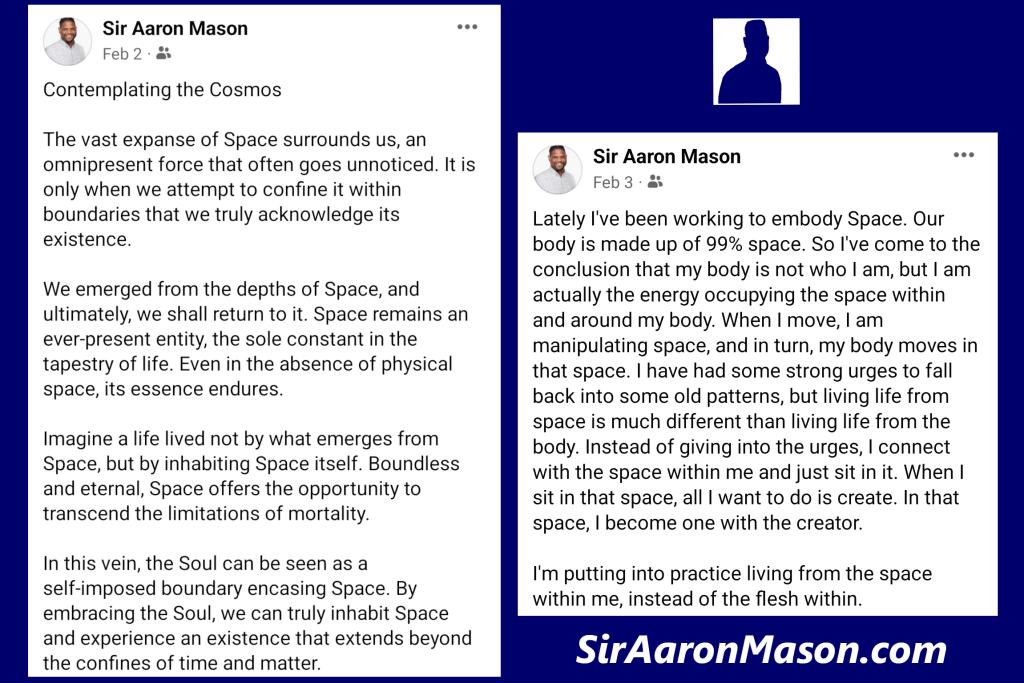
As I reflected on Terrence’s insights, I couldn’t help but draw parallels to a post I had shared on Facebook a few months prior—a contemplation on my personal beliefs about the nature of creation and divinity. In that post, I had expressed my belief in a higher power that transcends traditional religious constructs—a force that I perceived as consisting of space, the very medium through which all things come into existence.
For me, Terrence’s words provided a profound validation of my own spiritual experiences. The notion that the Flower of Life, like any creation, would be incomplete without acknowledging the space within it resonated deeply with my understanding of existence. It reminded me that true wisdom often lies not just in observing the tangible and visible aspects of life (represented by the lines of the Flower of Life) but also in embracing the intangible and subjective (represented by the space within).
In Terrence’s framework, the lines of the Flower of Life symbolize our objective experiences—things we can quantify and analyze with concrete certainty. Conversely, the space within represents our subjective experiences—a realm where we are free to imbue life with meaning, understanding, and personal significance.
In this subjective space, as I had posited in my earlier post, lies the potential for a profound connection with the creative essence of the universe. It’s here that we can truly align ourselves with the Creator—not merely as passive observers of creation, but as active participants in shaping our own realities.
As I continued my wait outside the therapist’s office, these thoughts swirled in my mind, reshaping my understanding of spirituality and existence. Terrence Howard’s unconventional blend of acting and physics had become a catalyst for deeper introspection—an invitation to explore the profound mysteries of life through the lens of the Flower of Life and the infinite space within.
Here are the post from February of 2024:
 SirAaronMason.com
Leave a comment